Taking new projectsCanvas course design
Canvas course pages, built from your course materials
I build Canvas unit hubs and before-class prep pages from your existing book, slides, and handouts. I do this instructional design work from Boston, remotely, and I taught high school math for more than twelve years.
Message me on LinkedInEmail contact@megan-warren.com
Fixed price, quoted by scope before any work starts. I reply within two business days.
What the unit hub and prep pages look like
Try the Trigonometry Unit 2 hub
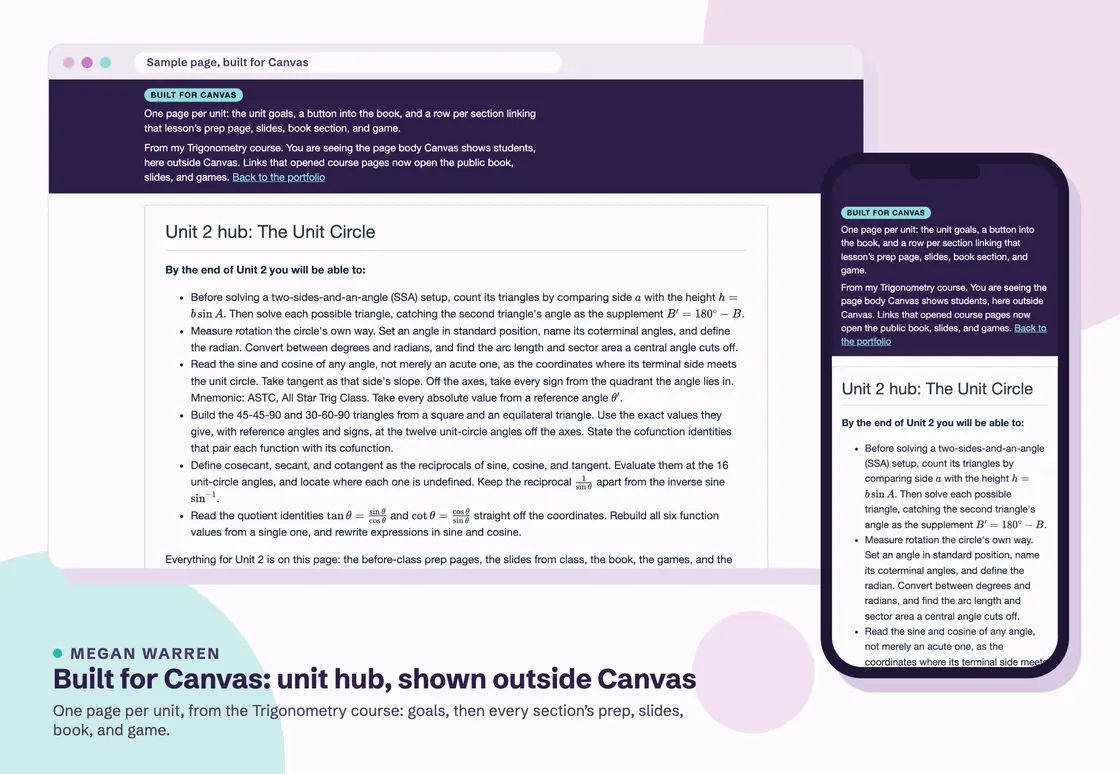
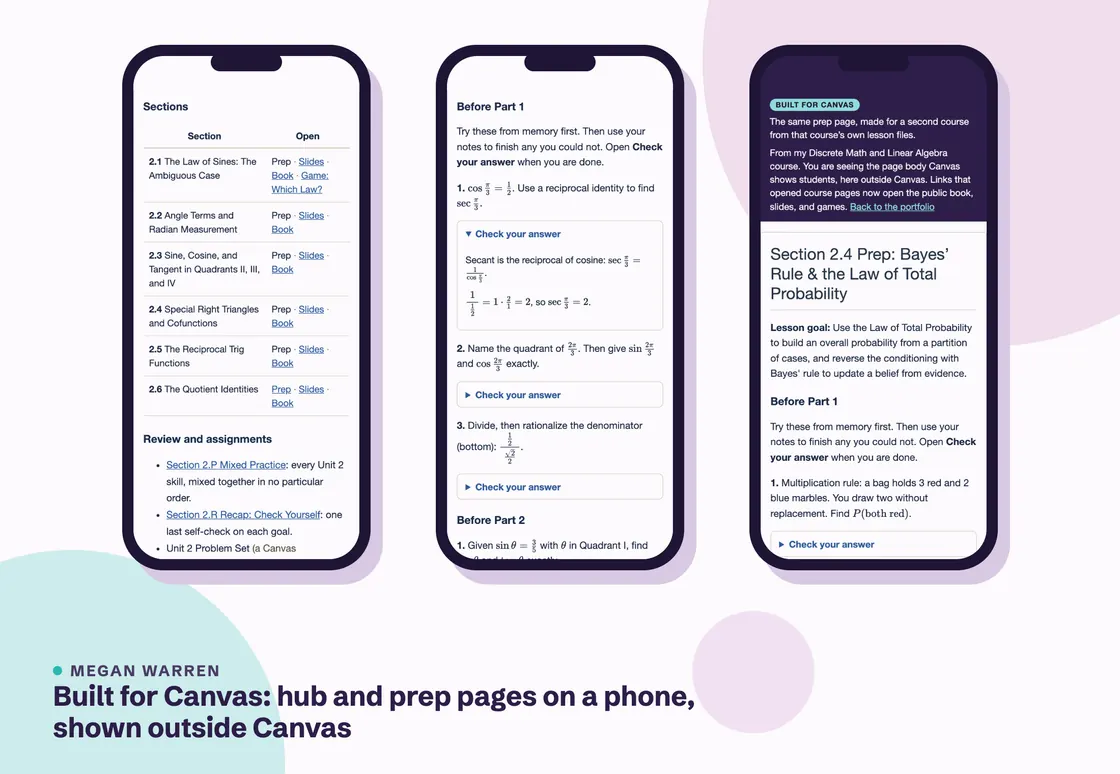
Below is the hub as students see it in Canvas, shown here outside it. The Prep links open each prep page right here, and the other links open the public book, slides, and games.
Open the unit hub (Trigonometry, Unit 2, with all six prep pages)
Unit 2 hub: The Unit Circle
By the end of Unit 2 you will be able to:
- Before solving a two-sides-and-an-angle (SSA) setup, count its triangles by comparing side with the height . Then solve each possible triangle, catching the second triangle's angle as the supplement .
- Measure rotation the circle's own way. Set an angle in standard position, name its coterminal angles, and define the radian. Convert between degrees and radians, and find the arc length and sector area a central angle cuts off.
- Read the sine and cosine of any angle, not merely an acute one, as the coordinates where its terminal side meets the unit circle. Take tangent as that side's slope. Off the axes, take every sign from the quadrant the angle lies in. Mnemonic: ASTC, All Star Trig Class. Take every absolute value from a reference angle .
- Build the 45-45-90 and 30-60-90 triangles from a square and an equilateral triangle. Use the exact values they give, with reference angles and signs, at the twelve unit-circle angles off the axes. State the cofunction identities that pair each function with its cofunction.
- Define cosecant, secant, and cotangent as the reciprocals of sine, cosine, and tangent. Evaluate them at the 16 unit-circle angles, and locate where each one is undefined. Keep the reciprocal apart from the inverse sine .
- Read the quotient identities and straight off the coordinates. Rebuild all six function values from a single one, and rewrite expressions in sine and cosine.
Everything for Unit 2 is on this page: the before-class prep pages, the slides from class, the book, the games, and the assignments.
Sections
| Section | Open | Practice | Games and activities |
|---|---|---|---|
| 2.1 The Law of Sines: The Ambiguous Case | Prep · Slides · Book | Exercises | Game: Which law? Try it: The ambiguous case |
| 2.2 Angle Terms and Radian Measurement | Prep · Slides · Book | Exercises | Try it: What a radian is |
| 2.3 Sine, Cosine, and Tangent in Quadrants II, III, and IV | Prep · Slides · Book | Exercises | Try it: The unit circle |
| 2.4 Special Right Triangles and Cofunctions | Prep · Slides · Book | Exercises | Game: The unit circle challenge |
| 2.5 The Reciprocal Trig Functions | Prep · Slides · Book | Exercises | |
| 2.6 The Quotient Identities | Prep · Slides · Book | Exercises | Game: The six-function challenge |
Review and assignments
- Section 2.R Recap: Check Yourself (one check per goal)
- Section 2.P Mixed Practice (every Unit 2 skill, shuffled)
- Unit 2 Problem Set (a Canvas assignment)
- Unit 2 Assessment (in class, on paper)
Section 2.1 Prep: The Law of Sines: The Ambiguous Case
Lesson goal: Count and solve every triangle that a two-sides-and-a-non-included-angle (SSA) setup allows.
Before Part 1
Try these from memory first. Then use your notes to finish any you could not. Open Check your answer when you are done.
1. In triangle , , , and side cm. Use the Law of Sines to find side , to three decimal places.
Check your answer
Pair each side with its opposite angle: .
Multiply both sides by : .
cm.
2. In a right triangle, the hypotenuse is and one acute angle is . How long is the side opposite that angle, to three decimal places?
Check your answer
Sine is opposite over hypotenuse: .
Opposite side .
3. A triangle has two angles measuring and . Find the third angle.
Check your answer
The three angles of a triangle add to .
Third angle .
Before Part 2
1. SSA count (Part 1): , , . How many triangles?
Check your answer
, so find the height.
.
: side cannot reach the base line. 0 triangles.
2. Law of Sines: in triangle , , , . Find side , to three decimal places.
Check your answer
.
.
3. An angle measures . What is its supplement (the angle that adds with it to )?
Check your answer
Supplementary angles add to .
.
One more from last time
State the Law of Cosines for side c.
Check your answer
.
Section 2.2 Prep: Angle Terms and Radian Measurement
Lesson goal: Measure any rotation in standard position, name its coterminal angles, convert between degrees and radians, and use the radian to compute arc length and sector area.
Before Part 1
Try these from memory first. Then use your notes to finish any you could not. Open Check your answer when you are done.
1. An angle in a triangle is . Find its supplement .
Check your answer
The supplement is .
.
2. A right triangle has an acute angle with opposite side and hypotenuse . (a) Write as a fraction. (b) Find with , to the nearest degree.
Check your answer
(a) Sine is opposite over hypotenuse: .
(b) With the calculator in degree mode, .
To the nearest degree, .
3. Name the quadrant of the point on the coordinate plane.
Check your answer
The -coordinate is negative, so the point is left of the -axis.
The -coordinate is positive, so the point is above the -axis.
Left of the -axis and above the -axis is Quadrant II.
Before Part 2
1. Find the angle in coterminal with .
Check your answer
Subtract a full turn: .
is in , so the answer is .
2. Take a -- right triangle and a -- right triangle. In each, find the sine of the angle opposite the shortest side. Why are the two values equal?
Check your answer
In the -- triangle, the opposite side is and the hypotenuse is , so the sine is .
In the -- triangle, the opposite side is and the hypotenuse is , so the sine is .
The second triangle is the first scaled by . The opposite side and the hypotenuse both double, so their ratio does not change.
3. Write the circumference and the area of a circle of radius .
Check your answer
Circumference: , the distance around the circle.
Area: .
One more from last time
How do you count SSA triangles by comparing a with the height h = b sin A?
Check your answer
Compute (A the given angle, b its adjacent side), then compare a with h and b.
Section 2.3 Prep: Sine, Cosine, and Tangent in Quadrants II, III, and IV
Lesson goal: Read sine and cosine as coordinates on the unit circle, name the sign of any angle from its quadrant (mnemonic: ASTC, All Star Trig Class), and evaluate anywhere with the reference angle for the absolute value and the quadrant for the sign.
Before Part 1
Try these from memory first. Then use your notes to finish any you could not. Open Check your answer when you are done.
1. Find the angle in coterminal with . Then name the quadrant its terminal side lands in.
Check your answer
Subtract one full turn: .
is between and .
Answer: , in Quadrant II.
2. For the point : (a) name its quadrant, (b) find its distance from the origin.
Check your answer
(a) Both coordinates are negative, so is in Quadrant III.
(b) Distance .
Answer: (a) Quadrant III; (b) .
3. A right triangle has an acute angle with opposite side , adjacent side , and hypotenuse . Find , , and .
Check your answer
.
.
.
Before Part 2
1. From ASTC: (a) In which quadrant is sine positive but cosine negative? (b) Which single function is positive in Quadrant III?
Check your answer
(a) Sine positive means , and cosine negative means . That is Quadrant II.
(b) In Quadrant III, and . Only is positive there.
2. Find the angle in coterminal with . Then name its quadrant.
Check your answer
Add one full turn: .
is between and .
Answer: , in Quadrant IV.
3. Compute and .
Check your answer
.
.
Subtractions like these give reference angles, coming up next.
One more from last time
Find the angle in coterminal with .
Check your answer
Section 2.4 Prep: Special Right Triangles and Cofunctions
Lesson goal: Build the two special right triangles from a square and an equilateral triangle, read the exact values of sine, cosine, and tangent at 30, 45, and 60 degrees, rebuild the first-quadrant table with the first-quadrant sine pattern, extend those values to all 16 unit-circle angles with reference angles and the ASTC mnemonic, and use the cofunction identities.
Before Part 1
Try these from memory first. Then use your notes to finish any you could not. Open Check your answer when you are done.
1. For : (a) name the quadrant, (b) find the reference angle , (c) say which of , , is positive there.
Check your answer
(a) is between and , so it is in Quadrant IV.
(b) The reference angle is .
(c) ASTC puts C in Quadrant IV, so only is positive there; and are negative.
2. (a) A right triangle has two legs equal to . Find the exact hypotenuse. (b) A second right triangle has a leg and hypotenuse . Find the exact other leg.
Check your answer
(a) Legs and : the hypotenuse is .
(b) Leg and hypotenuse : the other leg is .
3. Rationalize the denominator: (a) , (b) .
Check your answer
Multiply the numerator and the denominator by the radical in the denominator.
(a) .
(b) .
Before Part 2
1. From the special triangles, give the exact , , and of .
Check your answer
The -- triangle has sides , , .
, and .
2. For : (a) name the quadrant, (b) find the reference angle, (c) say which function is positive there.
Check your answer
(a) is between and , so it is in Quadrant IV.
(b) .
(c) In Quadrant IV only is positive.
3. Subtract the fractions: .
Check your answer
Use the common denominator : and .
.
One more from last time
On the unit circle, what are and ?
Check your answer
and , the coordinates of the crossing point
Section 2.5 Prep: The Reciprocal Trig Functions
Lesson goal: Evaluate cosecant, secant, and cotangent anywhere on the circle by taking the reciprocal of sine, cosine, or tangent. Keep the reciprocal (a number) apart from the output of an inverse trig function (an angle).
Before Part 1
Try these from memory first. Then use your notes to finish any you could not. Open Check your answer when you are done.
1. Evaluate exactly from the special-angle table: (a) , (b) , (c) .
Check your answer
(a) From the special-angle table, .
(b) From the table, .
(c) Tangent is sine over cosine: .
2. Rationalize each denominator: (a) , (b) .
Check your answer
(a) Multiply by , which equals : .
(b) Multiply by : .
3. Write the reciprocal of each number: (a) , (b) , (c) .
Check your answer
(a) Swap the numerator and the denominator: the reciprocal of is .
(b) , so its reciprocal is . The sign stays the same.
(c) , so its reciprocal is .
Before Part 2
1. Evaluate exactly: (a) , (b) .
Check your answer
(a) Secant is the reciprocal of cosine: .
(b) Cotangent is the reciprocal of tangent: .
2. For : (a) which quadrant? (b) what is the reference angle ? (c) what are the signs of and ?
Check your answer
(a) is between and , so it is in Quadrant II.
(b) .
(c) In Quadrant II, and .
3. Evaluate exactly: and .
Check your answer
The reference angle gives the absolute values and .
The Quadrant II signs give and .
One more from last time
What are the side ratios of the -- and -- triangles?
Check your answer
and
Section 2.6 Prep: The Quotient Identities
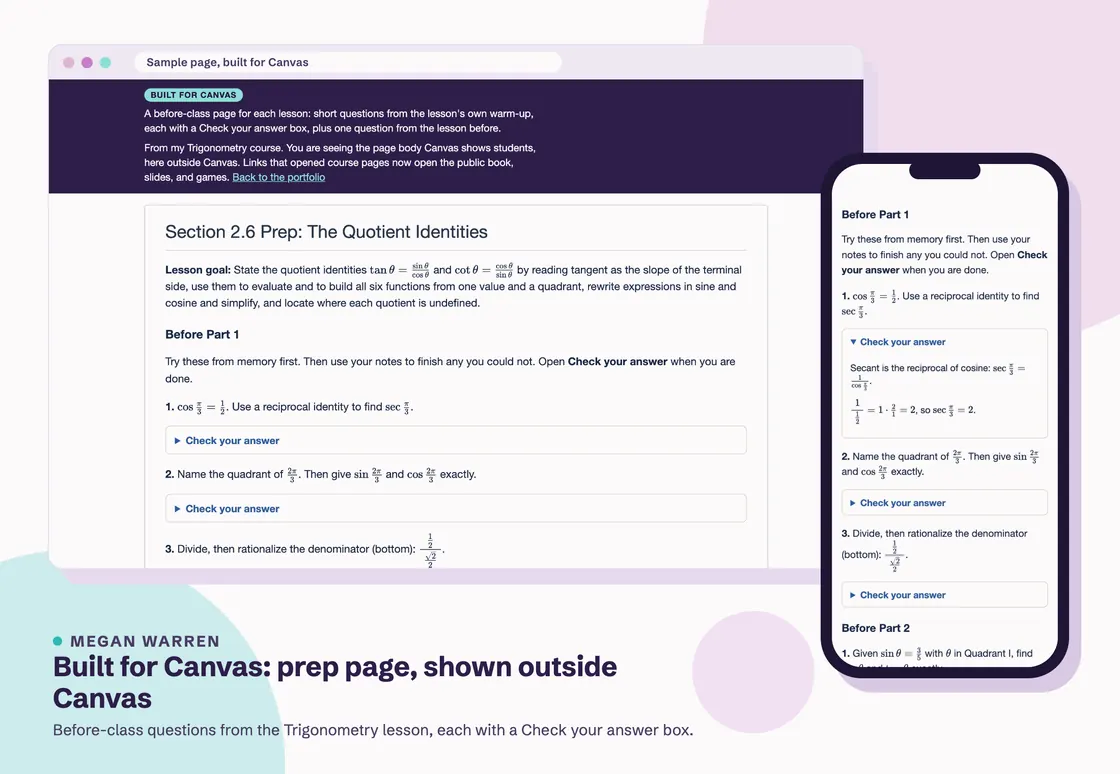
Lesson goal: State the quotient identities and by reading tangent as the slope of the terminal side, use them to evaluate and to build all six functions from one value and a quadrant, rewrite expressions in sine and cosine and simplify, and locate where each quotient is undefined.
Before Part 1
Try these from memory first. Then use your notes to finish any you could not. Open Check your answer when you are done.
1. . Use a reciprocal identity to find .
Check your answer
Secant is the reciprocal of cosine: .
, so .
2. Name the quadrant of . Then give and exactly.
Check your answer
is between and , so it is in Quadrant II.
Its reference angle is .
In Quadrant II, sine is positive and cosine is negative: and .
3. Divide, then rationalize the denominator (bottom): .
Check your answer
Dividing by a fraction is multiplying by its reciprocal: .
Rationalize: .
Before Part 2
1. Given with in Quadrant I, find and exactly.
Check your answer
Sizes: opposite and hypotenuse , so the adjacent side is .
Quadrant I makes every function positive: .
.
2. On : (a) where is undefined? (b) Why?
Check your answer
(a) At and .
(b) , and at those two angles. A fraction with denominator has no value.
3. Give and .
Check your answer
At the point is , so .
At the point is , so .
One more from last time
What are cosecant, secant, and cotangent?
Check your answer
The reciprocals of sine, cosine, tangent: , , .
What each Canvas page includes
- Unit goalsWhat students will be able to do by the end of the unit, with the math typeset.
- A table of sectionsEach section linked to its prep page, the book, the slides, and the games.
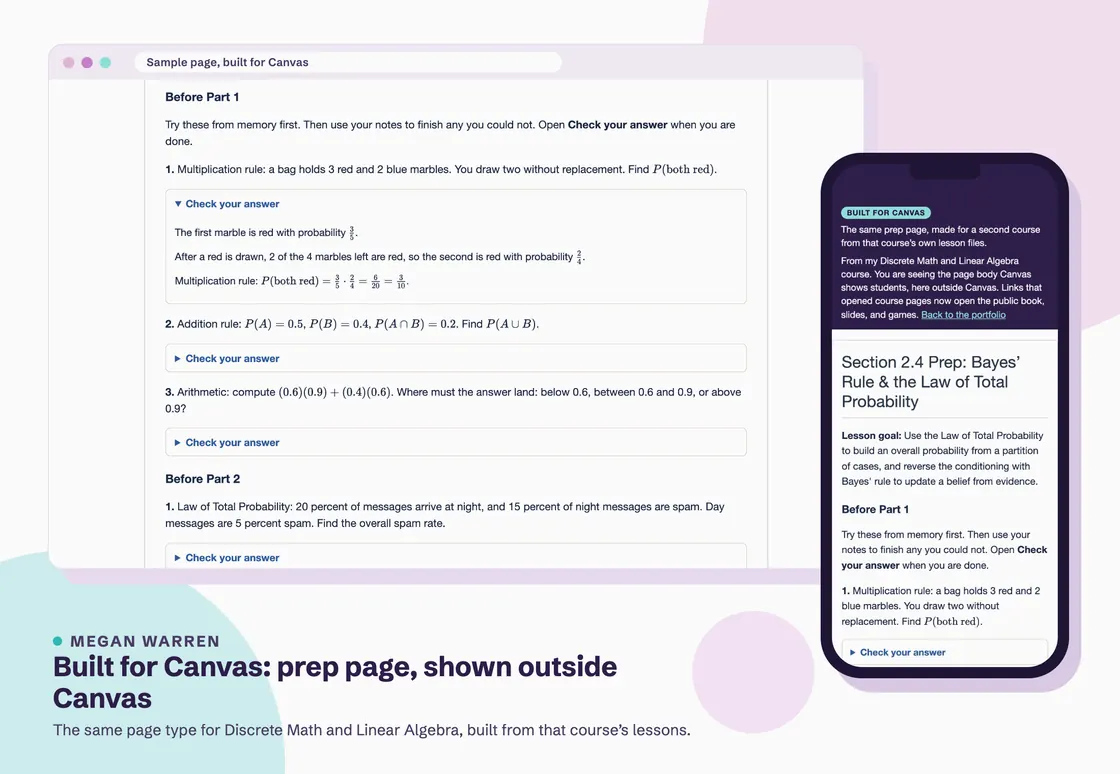
- A prep page for each sectionA short read before class, with “Check your answer” boxes that open to a worked answer.
How a Canvas project runs
- Tell me which course and which units.Send what you already have: the book, the slides, the handouts. An outline of the units is plenty.
- Get a fixed price and a date.Quoted by scope, before any work starts.
- Research comes first.I study your course, your students, and how your Canvas is set up, and I look up anything I’m not sure of.
- Get the finished pages.Ready to paste into Canvas, and you own the files and the source.
- Keep it current.I can show your team how to update them, or handle the updates myself whenever you need them.
Want Canvas pages built from your course materials?
Message me on LinkedInEmail contact@megan-warren.com
I reply within two business days, with a quote or a question.