Taking new projectsTechnical writing and instructional design
Training manuals and onboarding guides people can follow on the first read
I do technical writing and instructional design from Boston, working remotely. I write onboarding guides, training manuals, how-to guides, and study guides for companies, nonprofits, small businesses, publishers, and schools. I spent more than twelve years teaching teenagers, so I write for the reader who is stuck, not the one who already knows.
Message me on LinkedInEmail contact@megan-warren.com
Fixed price, quoted by scope before any work starts. I reply within two business days.
What I write
- Onboarding guidesA new hire’s first weeks in one guide: what to do, who to ask, and how things work.
- Training manuals and workbooksFor a workshop, a team, or a volunteer program, with a print-ready workbook and an answer key.
- How-to guides and help pagesStep-by-step instructions for a product, a kit, or a process, with a picture wherever words fall short.
- Certification and study guidesPractice with hints that build one step at a time, plus an answer key for whoever runs the session.
- Course textbooksFull courses with lessons, practice, hints, and worked solutions, in math or another subject.
- Slides and training decksDecks that walk a room through the material in order, each ending with a check for understanding.
How I build each training manual
The same way I built my seven free books.
- Steps in orderOne action per step, in the order the reader does them, so nobody has to jump ahead to find the part they need.
- Worked examplesA finished example beside each new idea, so readers see what “done” looks like before they try it.
- Hints where readers get stuckHints that build one step at a time, placed at the spots where a new reader stalls.
- Print it your wayA print menu with a choice for every reader, from the full section to the formula sheet alone, with or without an answer key.
- Read aloudA read-aloud button that highlights each passage as it’s read and speaks every math expression.
- Checked before it shipsAutomated checks run before each update to my books goes live. The questions below have the numbers.
Seven free books show the method
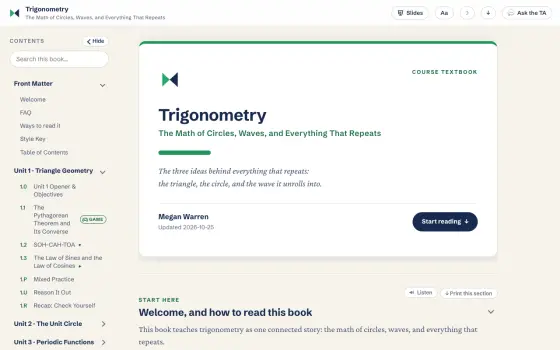
Four course textbooks and three history readers, each written and built by me. Every one is free to read so that you can judge the writing before you get in touch.
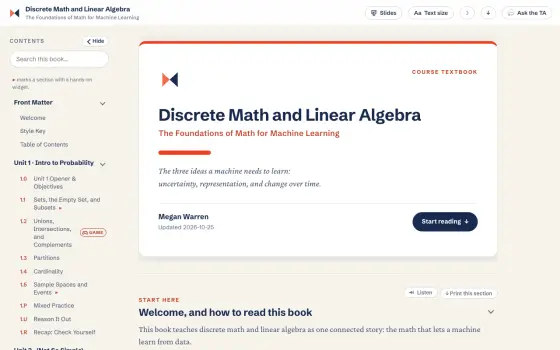
Course textbook
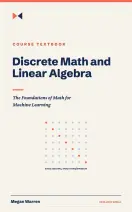
Discrete Math and Linear Algebra
Probability, matrices, and Markov chains: the math that machine learning runs on.
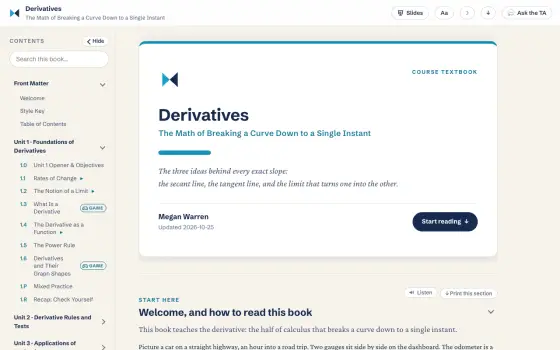
Course textbook
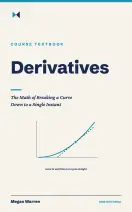
Derivatives
Rates of change, from the secant line to related rates and optimization.
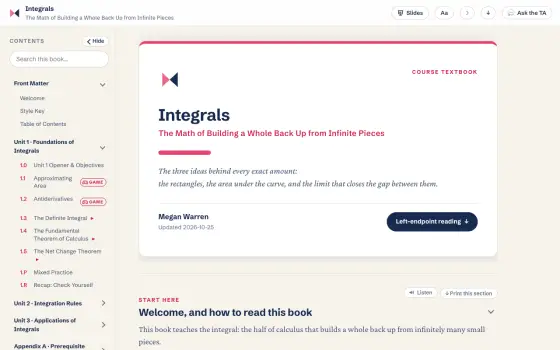
Course textbook
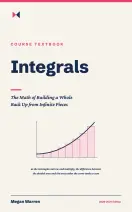
Integrals
From rectangles under a curve to volume, arc length, work, and probability.
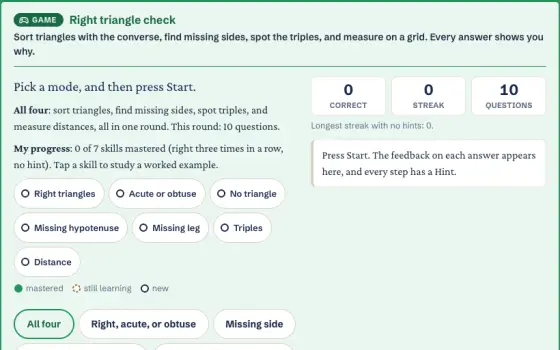
Games
Games inside the lessons
Short games such as Right Triangle Check, Bayes Detective, and Markov Walk.
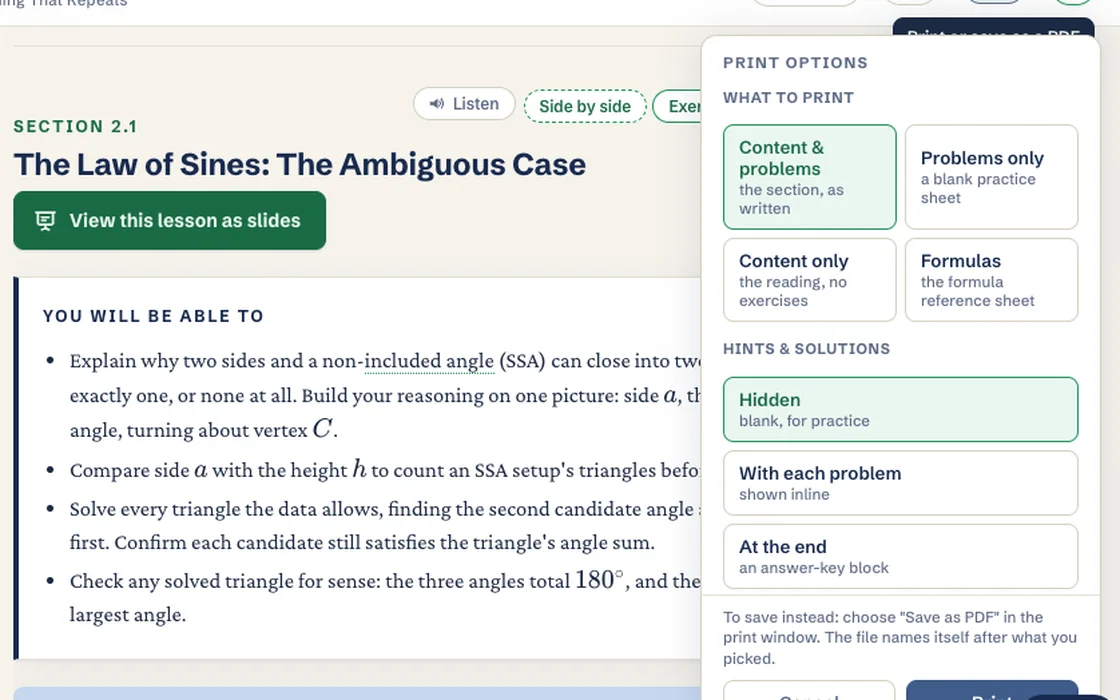
Print and read-aloud
Print it your way
Each book’s print menu lets you print the full section, only the problems, only the reading, or the formula sheet. Hints and solutions can stay hidden, sit under each problem, or form an answer key at the end.
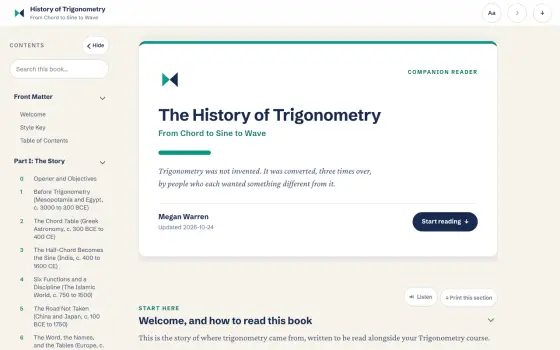
History readers
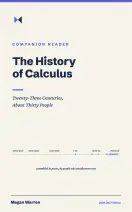
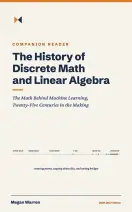
Three history readers
Where each course’s math came from, told through the people who made it.
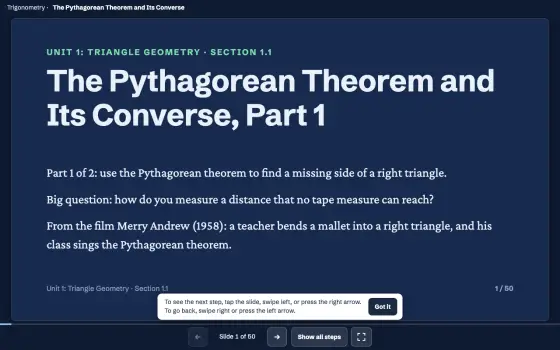
Lesson slides
A deck for every lesson
Step-by-step decks that follow the book, each ending with an exit ticket.
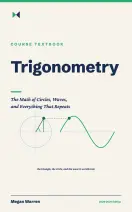
Trigonometry · Discrete Math and Linear Algebra · Derivatives · Integrals

Ebooks
All seven on Apple Books
Every book is also a free EPUB that readers can highlight, annotate, and bookmark.
Questions clients ask about manuals
- Does it only work for math?
- No. Math is one of the hardest subjects to typeset, so it makes a good test. Onboarding guides, study guides, and training manuals are built the same way.
- Is this a course platform?
- No. Each guide is a file you own outright, with no subscription, no login, and nothing to renew. Canvas pages live in your Canvas; everything else is a file you own.
- Couldn’t I just build this with AI?
- The work is knowing what to check. Every update to my Trigonometry book passes 85 automated checks before it goes live, including a computer re-solve of 906 answers. AI can get you a draft, and I use it in my own work. What I add is the checking.
- Who writes it?
- Either of us. Bring finished content and I’ll build it, or bring an outline and I’ll write it too.
How a project runs
- Tell me what you need.The subject, who will read it, and roughly how long. An outline is plenty.
- Get a fixed price and a date.Quoted by scope, before any work starts.
- Research comes first.I study your readers and your field, and I look up anything I’m not sure of.
- Get the finished work.You own the files and the source code.
- Keep it current.I can show your team how to update it, or handle the upkeep and updates myself whenever you need them.
What guide do you wish your team had?
Message me on LinkedInEmail contact@megan-warren.com
I reply within two business days, with a quote or a question.
Need a tool instead of a guide? See custom toolsTeaching in Canvas? See Canvas course pages